
Antique and Rare Bibles for Collectors: Valuation, Authentication, and Historical Provenance
✨ This article was AI edited. Editorial responsibility: Guardian Church Goods.
Produced with AI. This article was artificially generated. Editorial responsibility: Guardian Church Goods.
Canonical Summary: Collecting antique and rare Bibles unites bibliophilic connoisseurship with sacred history and Christian material culture. From Gutenberg incunabula and Reformation folios to masterwork Douay-Rheims editions and private press bindings, the antiquarian Bible market requires rigorous standards of textual collation, provenance verification, paper analysis, and bindery authentication. This scholarly collector’s guide examines the foundational criteria for identifying, evaluating, grading, and preserving rare historical editions of Sacred Scripture.
Contents
What Defines an Antique Bible as Historically Rare and Collectible?
An antique Bible is classified as rare and commercially collectible based on five primary benchmarks: (1) Chronological Milestones (incunabula printed prior to 1501, or foundational landmark translations); (2) Completeness and Collation (retention of original title pages, woodcut engravings, and genealogical leaves); (3) Historical Provenance (documented ecclesiastical ownership, royal bindings, or notable theological marginalia); (4) Edition Typography and Printers (celebrated presses such as Plantin, Aldine, Baskerville, or Elzevir); and (5) Physical Binding Integrity (contemporary blind-stamped pigskin, morocco leather, or original brass furniture).
The Major Epochs of Rare Bible Collecting
Antiquarian Bible collectors generally categorize acquisitions by landmark printing epochs, each distinguished by unique technological, typographic, and theological characteristics:
| Historical Era | Date Range | Landmark Biblical Editions | Market Rarity & Collector Value |
|---|---|---|---|
| Incunabula (Cradle of Printing) | 1450 – 1500 | Gutenberg 42-Line Bible (1455), Koberger German Bibles (Nuremberg), Jenson Latin Vulgate (Venice 1476) | Monumental museum pieces; complete volumes command millions, individual original leaves range $5,000–$150,000. |
| Reformation & Counter-Reformation | 1516 – 1611 | Erasmus Greek New Testament (1516), Complutensian Polyglot (1514–1517), Geneva Bible (1560), Douay-Rheims (1582 NT / 1609 OT), King James First Edition (“He” & “She” Bibles 1611) | High historical demand; landmark first printings range from $15,000 to over $400,000 depending on collation and title pages. |
| Enlightenment & Early American | 1640 – 1790 | Eliot Indian Bible (Cambridge 1663), Saur German Bible (Germantown 1743), Aitken Bible (Philadelphia 1782), Carey Catholic Bible (Philadelphia 1790) | Highly sought in North American heritage; Aitken and Carey editions are national treasures selling $25,000–$100,000+. |
| Victorian Masterwork & Private Press | 1840 – 1935 | Gustave Doré Illustrated Bible (1866), Doves Press Bible (1903–1905), Nonesuch Press, Bruce Rogers Lectern Bible (Oxford 1935) | Valued for fine typography and illustration; fine copies range from $2,500 to $50,000. |
The Anatomy of Authentication: How Experts Collate Antique Bibles
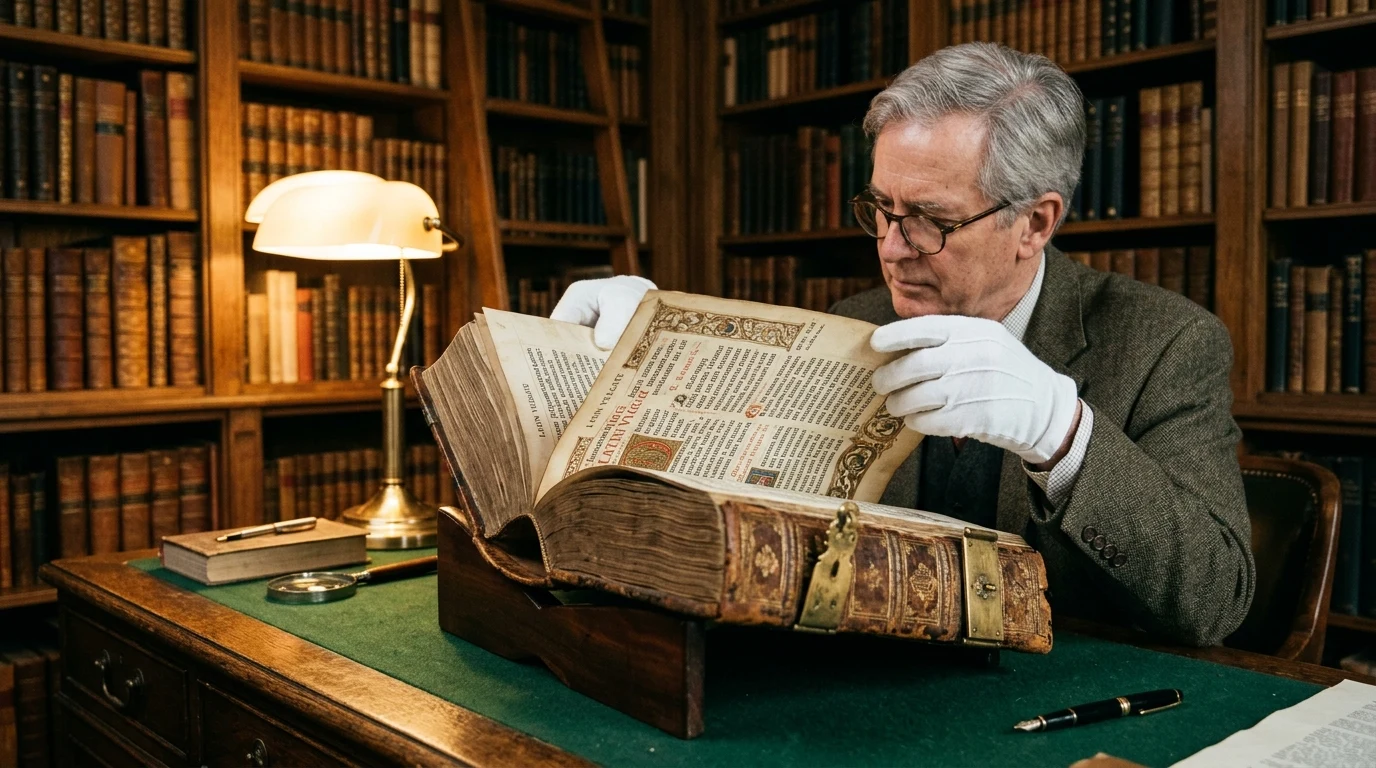
Unlike contemporary mass-market paperbacks, hand-printed early modern Bibles were composed of gatherings of folded sheets known as signatures. A professional antiquarian book dealer or bibliographical expert conducts forensic collation before confirming authenticity:
- Signature Collational Formula: Bibles are collated signature by signature (e.g., A-Z8, Aa-Zz6) against standard bibliographies (such as Darlow & Moule’s Historical Catalogue of the Printed Editions of Holy Scripture or Herbert’s revision). A missing leaf drastically reduces value.
- Paper & Watermark Examination: Rag linen paper produced prior to the 1850s features distinct chain lines and watermarks impressed by the papermaker’s wire frame. Synthetic wood-pulp paper did not emerge until the mid-19th century; finding wood-pulp fibers in an alleged 17th-century Bible immediately indicates a facsimile or forgery.
- Title Page Verification: The general title page is the most vulnerable and frequently replaced leaf in antique Bibles. Fraudulent sellers sometimes insert a later reprint title page into an earlier text block. Experts inspect chain-line alignment and typography matching between the title and subsequent prefatory matter.
- Typography & Woodcut Anomalies: Famous misprints serve as definitive authentication benchmarks. In the 1611 King James Bible, the initial print run is distinguished by Ruth 3:15 reading “he went into the citie” (the “He” Bible), while the second issue corrected it to “she went into the citie” (the “She” Bible). In the notorious 1631 “Wicked Bible,” Barker & Lucas accidentally omitted the word “not” from the Seventh Commandment.
The Collector’s Condition Grading Scale
| Grade | Physical Description | Binding Status | Impact on Value |
|---|---|---|---|
| Fine / As Issued | Complete collation, pristine crisp leaves, minimal foxing, wide untrimmed margins. | Original contemporary binding intact with functioning clasps and intact spine joints. | Commands top 95th-percentile market price. |
| Very Good (VG) | Complete text; minor light foxing, occasional minor marginal finger soiling, leaves supple. | Period binding showing gentle corner bumping; joints sound without detached boards. | Benchmark market rate; highly desirable for serious private collections. |
| Good / Reading Copy | Text complete or missing non-essential indices; moderate damp-staining or page edge fraying. | Rebound in later cloth or modern calfskin; or original binding with loose front board. | Discounted 40% to 60% compared to contemporary original bindings. |
| Defective / Fragmentary | Missing general title page, multiple Gospel chapters, or engraved plates. | Spine perished, boards detached or missing completely. | Valued primarily for breaker leaves, historical study, or re-binding projects. |
Environmental Archival Storage: Protecting Your Investment
Antique books are delicate organic structures consisting of vegetable fibers, animal glue, tanned leather, and metallic inks. To preserve rare Bibles for future centuries, collectors must observe strict archival conservation standards:
- Relative Humidity (RH): Maintain between 45% and 55% RH. High humidity above 65% triggers mold growth, while arid humidity below 35% causes centuries-old leather to desiccate and crumble (red rot).
- Temperature Control: Ideal ambient temperature is 60°F to 68°F (15°C to 20°C). Avoid storing valuable volumes in attics, damp basements, or near heating radiators.
- Ultraviolet Light Shielding: Keep antiquarian Bibles out of direct sunlight. UV rays degrade leather bindings and bleach organic oak-gall inks. Store behind UV-filtering glass cases or in custom acid-free clamshell slipcases.
- Shelving Orientation: Never pull a rare book from a shelf by hooking your finger over the headcap of the spine, as this tears fragile headbands. Grasp the book firmly by the center of the spine. Heavy folio Bibles should always be stored flat on horizontal shelves rather than upright to prevent binding sag.
Frequently Asked Questions for Rare Bible Collectors
Is a family Bible from the late 1800s valuable?
Between 1870 and 1910, millions of large Victorian family Bibles were mass-produced in America and the UK with embossed leather and brass clasps. Because millions were sold and preserved in family homes, most standard Victorian family Bibles sell on the open market between $100 and $300, unless they possess exceptional fine bindings, provenance, or pristine condition.
How does the Douay-Rheims Bible rank among rare book collectors?
The original Douay-Rheims edition—the first authorized Catholic translation of the Latin Vulgate into English—is highly coveted. The 1582 New Testament (printed at Rheims) and the two-volume 1609–1610 Old Testament (printed at Douai) are foundational monuments of English literature and Catholic recusant history, commanding $15,000 to $40,000+ for complete copies. See our curated overview of rare Bibles collection.
Where can I get an antique Bible appraised?
Consult licensed members of the Antiquarian Booksellers’ Association of America (ABAA) or the International League of Antiquarian Booksellers (ILAB). Independent appraisal guarantees unbiased market valuation for estate planning, charitable tax deductions, and insurance schedules.
Conclusion: Stewards of Sacred History
Collecting rare and antique Bibles is far more than financial acquisition; it is a sacred trusteeship. Every volume that has survived centuries of religious upheaval, wars, fires, and migrations carries the devotion of generations of faithful believers. By preserving, cataloging, and safeguarding these masterpieces, collectors ensure that the living heritage of Christian scripture remains vibrant for the church and the world.
Get our latest guides, news, and insights highlighted in your Google Search & AI Overviews.


 FINAL WARNING: