
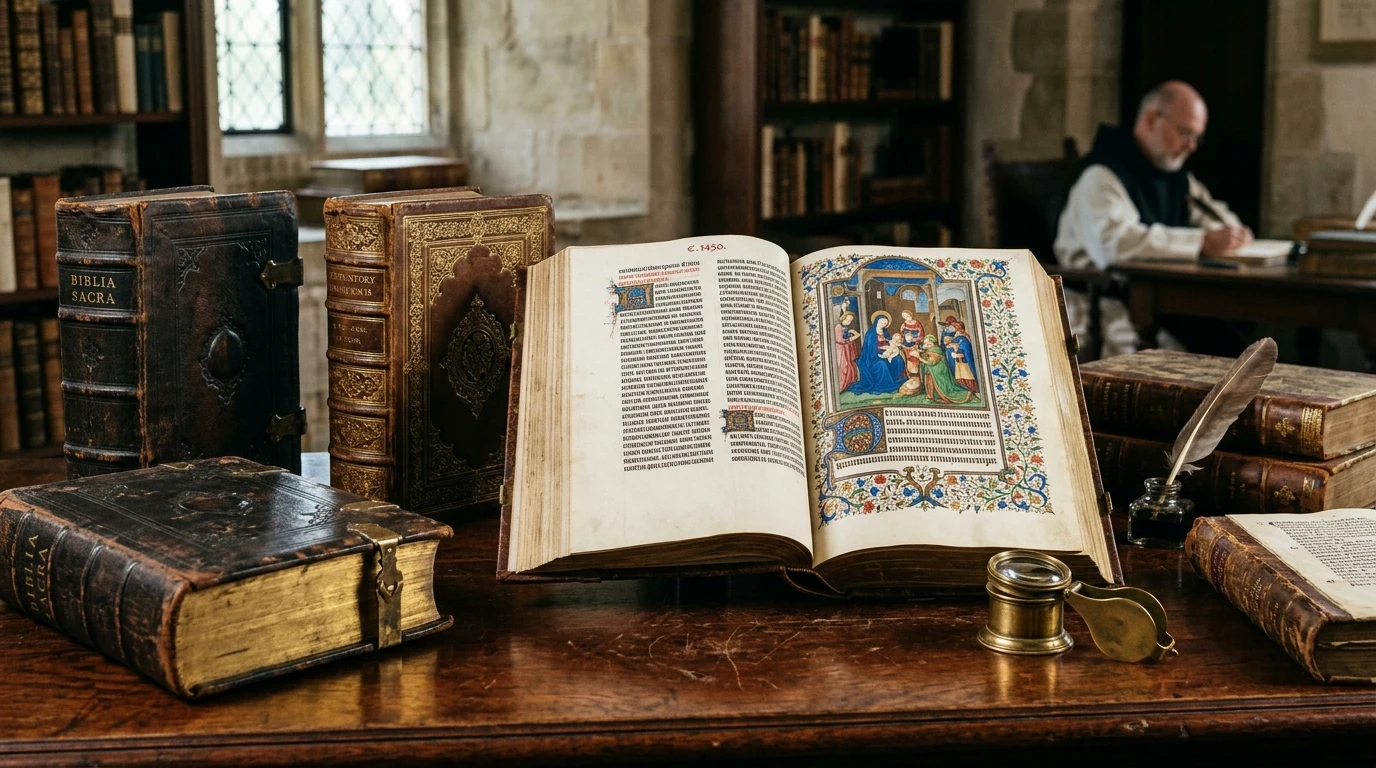
Old and Rare Bibles Collection — Identification & Care Guide
✨ This article was AI edited. Editorial responsibility: Guardian Church Goods.
Produced with AI. This article was artificially generated. Editorial responsibility: Guardian Church Goods.
An old and rare bibles collection encompasses historic printed scripture editions—including incunabula, early vernacular translations, illuminated polyglots, and milestone liturgical volumes—treasured for their theological significance, typographical craftsmanship, provenance, and critical role in the transmission of sacred Catholic and ecumenical Christian texts.
For centuries, sacred scripture has served as both the spiritual fountainhead of the Christian faith and the supreme canvas for Western typographical art and bookbinding craftsmanship. From monastic scriptoria where medieval scribes transcribed vellum codices with quill and gold leaf, to the invention of movable metal type by Johannes Gutenberg in Mainz, the physical Bible represents humanity’s highest intersection of theology, linguistic scholarship, and material preservation.
Today, curating an old and rare bibles collection attracts church historians, biblical scholars, institutional theological libraries, and passionate private collectors. Whether evaluating an incunabulum Latin Vulgate, an authentic first-edition Douay-Rheims Bible, or an antique family heirloom bound in blind-stamped calfskin, discerning collectors require rigorous analytical tools to authenticate, appraise, and conserve these fragile physical witnesses to divine revelation. This comprehensive handbook provides an authoritative guide to historic milestone editions, authentication forensics, valuation frameworks, archival preservation protocols, and theological custodianship.
Contents
- Landmark Historical Milestones in Rare Bible Collecting
- Core Authentication & Appraisal Forensics
- Comparison Matrix: Rare Historic Bible Editions & Valuation Benchmarks
- Archival Preservation, Climate Control, and Handling Standards
- Theological Custodianship: The Church’s Sacred Heritage
- Frequently Asked Questions Regarding Rare Bible Collections
Landmark Historical Milestones in Rare Bible Collecting
To evaluate and categorize historical scriptures accurately, collectors and curators organize volumes by chronologically distinct typographical and theological epochs. The following monumental editions define the pinnacle of rare Bible collecting:
1. Gutenberg Bible & Fifteenth-Century Incunabula (Pre-1501)
Any book printed with movable type in the West before January 1, 1501, is classified as an incunabulum (plural: incunabula, from the Latin for “swaddling clothes” or “cradle”). The Gutenberg Bible—printed between 1450 and 1455 by Johannes Gutenberg in Mainz, Germany—stands as the most valuable printed book in human history. Containing Saint Jerome’s Latin Vulgate text printed in two folio columns of 42 lines (hence the moniker “B42”), Gutenberg produced approximately 180 copies, of which fewer than 49 survive in varying degrees of completeness.
Other vital incunabula Bibles prized by Catholic collectors include the 1462 Fust and Schöffer Bible (the first printed book to carry a printed date and colophon), the 1475 Anton Koberger Nuremberg Latin Bible, and early German vernacular Bibles printed prior to the Protestant Reformation (such as the 1466 Mentelin Bible and the 1483 Koberger Ninth German Bible with hand-colored woodcuts).
2. The Complutensian Polyglot (1514–1517)
Commissioned and financed by the great Spanish prelate Cardinal Francisco Jiménez de Cisneros at the University of Alcalá de Henares (whose Latin name was Complutum), the Complutensian Polyglot is widely regarded by textual critics as the greatest scholarly printing achievement of the Renaissance. Spanning six monumental folio volumes, it displayed the biblical texts in parallel columns containing Hebrew, the Aramaic Targum Onkelos with Latin translation, the Greek Septuagint with interlinear Latin translation, and Saint Jerome’s Latin Vulgate occupying the central column of honor. Complete six-volume sets are exceptionally scarce and command institutional prominence.
3. Erasmus’s Novum Instrumentum Omne (1516)
Published in Basel by Johann Froben, Desiderius Erasmus of Rotterdam’s Novum Instrumentum omne was the first published (marketed) Greek New Testament in history. Erasmus printed the original Greek text in parallel with his own revised, elegant Latin translation, challenging several translation inaccuracies that had crept into medieval manuscript copies of the Vulgate. First editions from 1516, along with the corrected 1519 second edition (which Martin Luther utilized for his German translation), represent essential cornerstones for academic and historical scripture collections.
4. The Douay-Rheims Bible (1582 NT, 1609–1610 OT)
For Roman Catholic collectors, the Douay-Rheims Bible is of supreme doctrinal, historical, and sentimental value. Translated from the Latin Vulgate by exiled English Catholic scholars at the English College in Rheims (New Testament, printed 1582 by John Fogny) and Douai (Old Testament, printed in two quarto volumes in 1609 and 1610 by Laurence Kellam), this translation was produced under the leadership of Gregory Martin and Cardinal William Allen during the Elizabethan persecutions.
The first editions are characterized by dense, scholarly marginal glosses, robust defense of Catholic sacramental theology against Protestant translations, and a deeply Latinate vocabulary that heavily influenced the language of the 1611 King James translators. Copies with intact title pages, errata sheets, and original period bindings are extremely coveted in the international antiquarian market.
5. The King James Bible (1611 Editio Princeps)
Commissioned by King James I of England and translated by six committees of scholars in Oxford, Cambridge, and Westminster, the 1611 King James Bible is celebrated as a monumental masterpiece of English literature. First folio editions are famously distinguished into two states based on the typographical variation in Ruth 3:15:
- The “Great ‘He’ Bible” (True First Issue): Reads “and he went into the city” at Ruth 3:15, reflecting the masculine Hebrew pronoun.
- The “Great ‘She’ Bible” (Second Issue/1613): Corrects the reading to “and she went into the city.”
A genuine 1611 first folio possessing the engraved title page by Cornelis Boel, the double-page map of Canaan by John Speed, and complete Genealogies is among the most prestigious centerpieces of any comprehensive scripture collection.
6. The Clementine Vulgate (1592)
Following the decrees of the Council of Trent mandating an official, standardized edition of Saint Jerome’s Latin text, Pope Clement VIII issued the Biblia Sacra Vulgatae Editionis in 1592. Superseding the flawed 1590 Sixtine edition, the Clementine Vulgate became the universal liturgical and theological standard of the Roman Catholic Church for nearly four centuries until the promulgation of the Nova Vulgata in 1979. Copies of the 1592 Editio Princeps are masterworks of Vatican printing history.
Core Authentication & Appraisal Forensics
Evaluating antique Bibles requires rigorous bibliographical methodology to prevent costly acquisitions of sophisticated facsimiles, assembled composites (“sophisticated copies”), or missing gatherings. Certified antiquarian appraisers utilize five primary forensics:
- Collation and Gathering Completeness: Unlike modern books with standardized Arabic page numbers, early Bibles were assembled by quires or “gatherings” marked by signature letters (e.g., A–Z, Aa–Zz) at the bottom of the recto leaves. A rare Bible must be collated page-by-page against established bibliographical reference catalogues (such as Darlow & Moule’s Historical Catalogue of the Printed Editions of Holy Scripture, Herbert, or STC/ESTC). Missing signature leaves, unrecorded cancels, or tipped-in facsimile pages severely impact commercial and historical value.
- Paper Stock and Chain-Line Watermarks: Before the invention of industrial wood-pulp paper in the mid-19th century, books were printed on rag paper made from linen and cotton fibers. Holding leaves against backlighting reveals distinct horizontal laid lines, vertical chain lines, and manufacturer watermarks. Watermarks allow bibliographers to date paper stock with remarkable precision and distinguish period sheets from 19th-century photolithographic reproductions.
- Binding Authenticity and Condition: An original contemporary binding—whether pigskin over oak boards with functioning brass clasps, blind-tooled calfskin, or gold-embossed morocco leather—adds 50% to 200% to the value of an early printed Bible compared to a 19th- or 20th-century rebinding. Rebinding, while sometimes structurally necessary for preservation, should preserve period character without trimming page margins.
- Provenance and Historical Marginalia: Documentation of institutional ownership (monastic ex-libris inscriptions, royal armorial bookplates, or notations by renowned scholars) transforms a standard copy into an artifact of specific historical provenance. In domestic vernacular Bibles, intact handwritten family genealogical records across centuries provide invaluable genealogical and social history.
- Defects and Alterations: Appraisers closely scrutinize volumes for “washing” (chemical washing to remove stains, which weakens paper fibers), modern leaf insertions, repaired tears using non-archival tape, and remargining (grafting new margins onto trimmed leaves).
Comparison Matrix: Rare Historic Bible Editions & Valuation Benchmarks
| Edition & Year | Linguistic & Theological Tradition | Key Identifying Markers | Scarcity & Valuation Tier |
|---|---|---|---|
| Gutenberg Bible (c. 1455) | Latin Vulgate (Catholic) | 42 lines/column, gothic textura typeface, rag paper or vellum | Tier 1 Institutional ($25M–$50M+ complete) |
| Complutensian Polyglot (1514–17) | Hebrew, Aramaic, Greek, Latin (Catholic) | 6 folio volumes, parallel columns, Alcalá university crest | Tier 2 Monumental ($150,000–$350,000) |
| Douay-Rheims NT (1582) | English from Latin Vulgate (Catholic) | Quarto format, John Fogny imprint, anti-heresy polemical glosses | Tier 3 Highly Desirable ($8,000–$25,000) |
| Douay OT (1609–1610) | English from Latin Vulgate (Catholic) | Two quarto volumes, Laurence Kellam imprint, Douai colophon | Tier 3 Highly Desirable ($10,000–$30,000 set) |
| King James “He” Bible (1611) | English Protestant / Church of England | Large folio, black letter type, Ruth 3:15 reading “he went” | Tier 2 Monumental ($100,000–$400,000+) |
| Clementine Vulgate (1592) | Latin Vulgate (Official Catholic) | Vatican Press imprint, papal bull of Clement VIII, engraved title | Tier 3 Highly Desirable ($15,000–$45,000) |
Archival Preservation, Climate Control, and Handling Standards
Rare Bibles are organic composite artifacts composed of animal skins (vellum, calf, morocco), vegetable fibers (linen, cotton, wood pulp), animal glues, iron-gall inks, and metallic stamping foils. Without museum-grade conservation stewardship, environmental deterioration can rapidly destroy centuries of preservation:
- Relative Humidity (RH) and Temperature Stabilization: The optimal storage environment requires a steady temperature of 60°F–68°F (15°C–20°C) and a strictly maintained relative humidity of 45% to 50% (±5%). Fluctuations in humidity trigger destructive expansion and contraction: dry air causes vellum bindings to warp violently and paper to crack, while humidity above 60% fosters active fungal mildew growth and promotes catastrophic foxing (iron oxidation spots).
- Ultraviolet (UV) Radiation Shielding: Light exposure causes irreversible photochemical degradation, fading colored illuminations, yellowing historic paper, and embrittling leather bindings. Store rare volumes away from direct sunlight in dark archival cabinets fitted with UV-filtering glass or museum-grade LED lighting (50 lux maximum during display).
- Custom Archival Enclosures (Clamshell Boxes): Fragile early volumes should not be forced onto tightly packed modern bookshelves. Protect damaged or highly valuable editions in custom-fitted, acid-free, lignin-free phase boxes or cloth-bound clamshell boxes (solander cases). These enclosures protect against particulate dust, atmospheric pollutants, and accidental handling abrasions.
- Ergonomic Handling Protocols: When opening heavy folio or quarto Bibles, never force the covers flat onto a hard table, as this snaps the fragile spine sewing cords and tears endpapers. Always rest the volume in a contoured book cradle or foam wedge supports angled at 90° to 120°. While white cotton gloves were historically standard, contemporary paper conservators mandate clean, thoroughly washed, dry hands (or powder-free nitrile gloves for delicate illuminations) to ensure tactile dexterity and prevent catching fragile page margins.
Theological Custodianship: The Church’s Sacred Heritage
For the Christian collector, an old Bible is fundamentally different from a secular rare book. It is a vessel of divine revelation that has mediated the grace of Christ across generations. In the Roman Catholic tradition, sacred objects dedicated to divine worship—including liturgical books that have rested upon holy altars—carry sacramental dignity.
Canon 1189 of the Code of Canon Law specifically urges that sacred images, historic vestments, and precious liturgical books of artistic or historical value must not be alienated or dispersed without the permission of the competent ecclesiastical authority. When private collectors acquire these volumes, they serve not merely as temporal owners, but as reverent custodians safeguarding the treasures of the Church for generations yet unborn.
Frequently Asked Questions Regarding Rare Bible Collections
Q1: How can I tell if an old family Bible is historically rare and valuable?
A1: While many families possess large Victorian or Edwardian family Bibles dating from 1860 to 1910 featuring heavy brass clasps and embossed leather, the vast majority were mass-produced in millions of copies on early wood-pulp paper. Their value is primarily sentimental and genealogical, typically retailing between $50 and $250 unless possessing royal provenance or unique historical associations. Bibles printed before 1800, early vernacular translations (e.g., Douay-Rheims, Geneva, Tyndale), and incunabula (pre-1501) constitute genuine antiquarian rarities.
Q2: Where should I look to identify the exact printer, date, and edition of an antique Bible?
A2: The primary bibliographical information is located on the title page of both the Old and New Testaments, which typically specifies the city, printer’s imprint, and publication year. In early Bibles where the title page is missing (a common defect), consult the colophon at the very end of the volume. If both title and colophon are lost, identification requires collating signature markings, examining specific woodcut initials, and checking diagnostic typographical translation variations (such as the “Breeches Bible” in Genesis 3:7 or the “He Bible” in Ruth 3:15).
Q3: Should I attempt to repair a detached leather Bible cover using store-bought leather conditioner or tape?
A3: Absolutely not. Never use commercial pressure-sensitive tapes (such as Scotch tape, duct tape, or electrical tape) or off-the-shelf leather dressings (like Neatsfoot oil or shoe creams). These products contain acidic adhesives and heavy oils that permanently stain paper, cause chemical migration, oxidize leather, and render future professional restoration impossible. Structural repairs should be entrusted exclusively to a professional book conservator certified by organizations like the American Institute for Conservation (AIC).
Q4: What makes a Catholic Douay-Rheims Bible distinct from a Protestant Geneva or King James Bible?
A4: The Douay-Rheims is translated directly from Saint Jerome’s Latin Vulgate (declared authentic by the Council of Trent) rather than the Hebrew Masoretic and Greek Textus Receptus utilized by Reformation translators. Furthermore, the Douay-Rheims includes the seven deuterocanonical books (Tobit, Judith, Wisdom, Sirach, Baruch, 1 and 2 Maccabees, plus additions to Esther and Daniel) fully integrated within the Old Testament, accompanied by extensive patristic theological commentary refuting Protestant doctrinal positions.
Published by GuardianChurchGoods.com — Dedicated to sacred scripture scholarship, Catholic liturgical tradition, rare church goods, and archival preservation.
Get our latest guides, news, and insights highlighted in your Google Search & AI Overviews.


 WAIT! YOUR DIVINE CONNECTION IS BLOCKED