
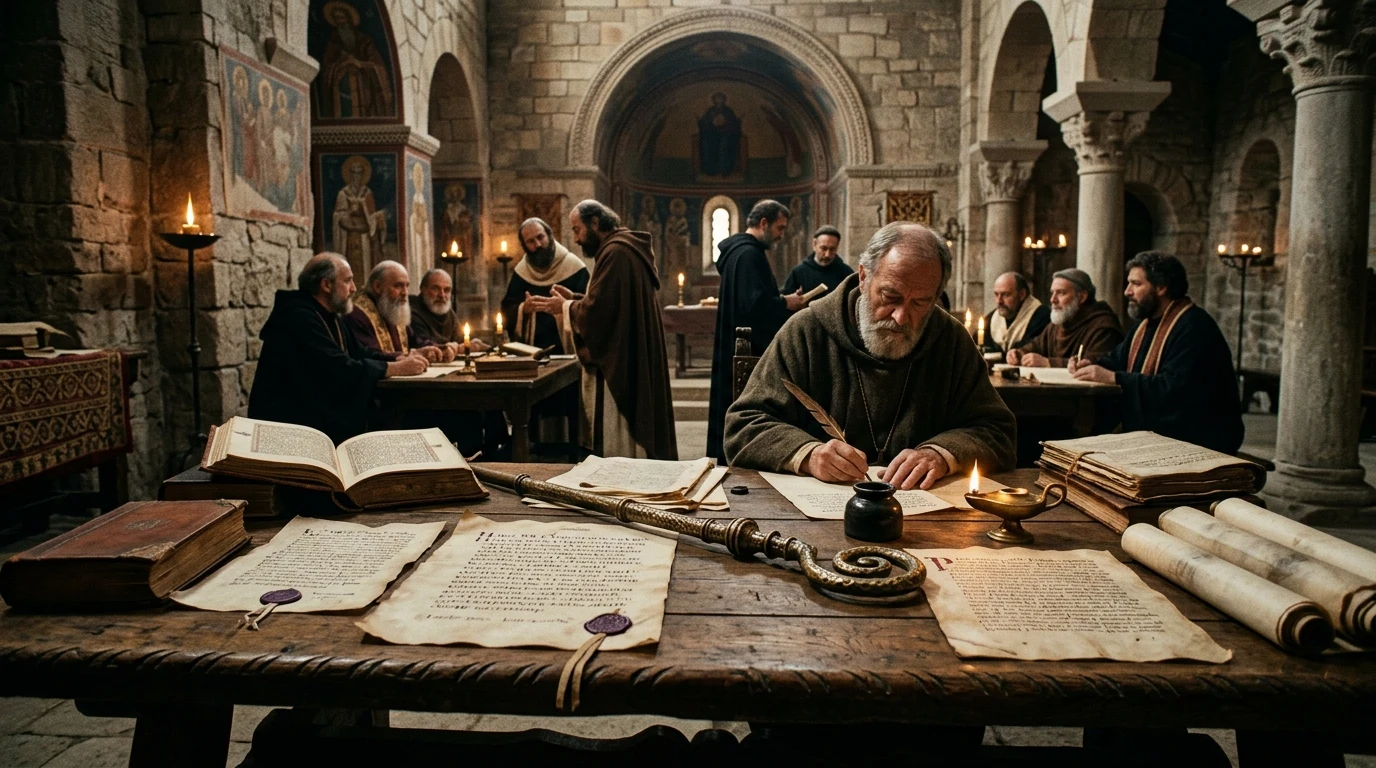
Misinterpretations by Early Catholic Bishops — Patristic Guide
✨ This article was AI edited. Editorial responsibility: Guardian Church Goods.
Produced with AI. This article was artificially generated. Editorial responsibility: Guardian Church Goods.
Misinterpretations by early Catholic bishops refers to the historical theological disputes and christological errors articulated by certain early episcopal leaders—such as Arius, Nestorius, Apollinaris, and Donatus—which prompted the Church to convene Ecumenical Councils, formulate dogmatic creeds, and establish apostolic tradition as the authoritative standard of orthodox faith.
The history of early Christianity was neither an idyllic, frictionless consensus nor a static philosophical school. Rather, the first seven centuries of the Church represented a rigorous intellectual crucible wherein the mysteries of divine revelation—most notably the Holy Trinity, the dual natures of Jesus Christ, the efficacy of the sacraments, and the nature of grace—were formulated, rigorously debated, and dogmatically defined. In this high-stakes theological struggle, not every early bishop, presbyter, or scholar arrived at orthodox conclusions.
Examining misinterpretations by early catholic bishops provides profound historical insight into how Catholic dogma developed and how the Magisterium exercised discernment. Far from undermining the authority of the Church, the honest historical examination of episcopal errors demonstrates how the Holy Spirit guided the universal body of bishops, in communion with the See of Rome, to isolate private theological misinterpretations and preserve the pure deposit of apostolic faith (depositum fidei). This comprehensive patristic guide examines the primary theological controversies involving early episcopal figures, the criteria used to discern authentic orthodoxy, the pivotal ecumenical councils, and lasting lessons for contemporary ecclesial unity.
Contents
- The Patristic Crucible: Why Early Theological Conflicts Arose
- Major Episcopal Controversies and Early Doctrinal Misinterpretations
- Comparison Matrix: Patristic Theological Misinterpretations & Resolutions
- How the Church Discerned Orthodoxy: The Vincentian Canon and Apostolic Succession
- Contemporary Lessons for Church Unity and Liturgical Life
- Frequently Asked Questions: Early Episcopal Misinterpretations
The Patristic Crucible: Why Early Theological Conflicts Arose
To understand how prominent and erudite bishops fell into grave doctrinal misinterpretations, one must appreciate the intellectual context of the late Roman Empire. The early Church received the divine revelation of Jesus Christ through Sacred Scripture and apostolic oral preaching. However, moving from biblical proclamation to precise ontological definitions required synthesizing biblical Hebrew categories with classical Greek philosophical vocabulary (such as ousia, hypostasis, physis, and prosopon).
Without standardized dogmatic vocabularies, brilliant bishops often emphasized one aspect of divine truth to such an extreme that they obscured or denied another complementary truth:
- The Dilemma of Monotheism vs. the Trinity: How can God be strictly one, while Father, Son, and Holy Spirit are each truly God? Over-emphasizing divine unity produced Modalism (denying real distinctions of persons), while over-emphasizing distinct roles produced Subordinationism and Arianism.
- The Mystery of the Incarnation: How can Jesus Christ be simultaneously fully divine and fully human? Emphasizing Christ’s divinity at the expense of his humanity produced Monophysitism and Apollinarianism; emphasizing his distinct natures to the point of separating him into two subjects produced Nestorianism.
- Sacramental Efficacy vs. Moral Purity: Does the validity of a sacrament depend upon the holiness of the minister? This fundamental dispute between North African bishops birthed the Donatist Schism.
Major Episcopal Controversies and Early Doctrinal Misinterpretations
1. Bishop Arius and the Eusebian Faction (Arianism & Subordinationism)
Though Arius was a presbyter in Alexandria, his radical subordinationist teachings were championed, defended, and politically weaponized by prominent bishops, most notably Eusebius of Nicomedia (later Bishop of Constantinople) and Eusebius of Caesarea (the celebrated church historian). Arius taught that the Logos (the Son) was not co-eternal with the Father, but was rather the first and highest created being: “There was a time when he was not” (ēn pote hote ouk ēn).
This misinterpretation threatened the absolute foundation of Christian soteriology (salvation theology). As Saint Athanasius of Alexandria famously retorted, if Jesus Christ is a creature—no matter how exalted—he cannot unite fallen humanity with God, for only God can save. The First Ecumenical Council of Nicaea (325 AD), convened by Emperor Constantine and led by papal legates alongside bishops like Hosius of Cordoba, rejected this episcopal misinterpretation by formulating the landmark creedal term homoousios (consubstantial / of the same essence as the Father).
2. Patriarch Nestorius of Constantinople (Nestorianism and the Title Theotokos)
In 428 AD, Nestorius, a gifted and ascetical Syrian monk educated in the Antiochian school of biblical theology, was elevated to the prestigious episcopal throne of Constantinople. Nestorius objected to the ancient and widespread Catholic liturgical title Theotokos (“God-Bearer” or “Mother of God”) applied to the Blessed Virgin Mary. Fearing that calling Mary “Mother of God” implied that the divine nature had an earthly origin, Nestorius argued that Mary should merely be titled Christotokos (“Christ-Bearer”).
However, Nestorius’s linguistic hesitation masked a catastrophic christological error: by separating the human and divine operations in Christ, he effectively posited two distinct persons (a divine person and a human person) loosely united in a moral conjunction. Saint Cyril of Alexandria vehemently opposed Nestorius, asserting that in the Incarnation, the eternal Word united human nature to his divine person in an indivisible hypostatic union. Therefore, Mary truly gave birth to the person of Jesus Christ, who is God; to deny Mary the title Theotokos was fundamentally to deny the Incarnation. The Council of Ephesus (431 AD) formally deposed Nestorius and dogmatically ratified the title Theotokos.
3. Bishop Apollinaris of Laodicea (Apollinarianism)
Apollinaris, Bishop of Laodicea (c. 310–390), was initially a staunch defender of Nicene orthodoxy and an intimate friend of Saint Athanasius. However, in his zealous attempt to counter Arianism, Apollinaris committed a grave theological overcorrection. He argued that in Jesus Christ, the divine Logos replaced the rational human soul (or human mind, nous), leaving Christ with a human body and sensitive soul, but without a human intellect.
The Cappadocian Father Saint Gregory of Nazianzus immediately recognized the fatal consequence of this misinterpretation, formulating one of the most famous theological axioms in Christian history:
“What is not assumed is not redeemed; but what is united to God is also being saved.”
If Christ did not assume a fully rational human mind, the human mind—the epicenter of fallen humanity’s disobedience and pride—remained unhealed and unredeemed. The First Council of Constantinople (381 AD) formally condemned Apollinarianism, defining Christ’s complete and uncompromised human nature.
4. The Donatist Schism: Bishop Donatus of Casae Nigrae
Following the brutal Diocletianic Persecution (303–305 AD), a severe crisis erupted among North African bishops. A faction led by Bishop Donatus insisted that Catholic bishops who had surrendered sacred scriptures to Roman authorities (termed traditores) had lost their episcopal authority. Consequently, Donatists claimed that any ordination, baptism, or sacrament performed by an unworthy minister was null and void.
Saint Augustine of Hippo dedicated decades of his episcopal ministry to refuting this error. Augustine established the essential Catholic distinction between the subjective holiness of the human minister and the objective efficacy of the sacrament. Because Jesus Christ is the primary, invisible minister of every sacrament, the sacraments work ex opere operato (“by the very work worked”). An unworthy priest or bishop does not invalidate Holy Mass or Baptism, for the grace flows from Christ, not the fallen human instrument.
Comparison Matrix: Patristic Theological Misinterpretations & Resolutions
| Episcopal Figure / Movement | Historical Date | Theological Misinterpretation | Orthodox Council & Resolution |
|---|---|---|---|
| Eusebius & Arius (Alexandria / Nicomedia) | 318–325 AD | Christ is a creature; not equal or co-eternal with the Father | Nicaea I (325 AD): Homoousios (consubstantial) dogma defined |
| Apollinaris (Bishop of Laodicea) | 360–381 AD | Divine Logos replaces the rational human soul/mind in Christ | Constantinople I (381 AD): Full human intellect affirmed |
| Nestorius (Patriarch of Constantinople) | 428–431 AD | Separates Christ into two subjects; rejects Mary as Theotokos | Ephesus (431 AD): Hypostatic Union & Theotokos dogmatized |
| Donatus (Bishop of Casae Nigrae) | 311–411 AD | Sacramental validity depends on moral perfection of the bishop | Synod of Carthage (411 AD): Ex opere operato efficacy defined |
| Eutyches & Dioscorus (Alexandria) | 448–451 AD | Human nature absorbed by divinity into a single nature (Monophysitism) | Chalcedon (451 AD): Two natures unconfused and undivided |
How the Church Discerned Orthodoxy: The Vincentian Canon and Apostolic Succession
Faced with competing interpretations defended by eloquent and influential bishops, how did early Christians know where authentic Catholic truth resided? The early Church established three infallible pillars of discernment:
- The Vincentian Canon: In 434 AD, Saint Vincent of Lérins articulated the classical rule of Catholic tradition in his Commonitorium:
“In the Catholic Church itself, all possible care must be taken, that we hold that faith which has been believed everywhere, always, by all” (quod ubique, quod semper, quod ab omnibus creditum est).
No individual bishop—regardless of his oratorical brilliance or administrative power—possesses the authority to invent novel doctrines contrary to the universal consensus of historical antiquity.
- Apostolic Succession and the Roman Primacy: As early as 180 AD, Saint Irenaeus of Lyons in Adversus Haereses demonstrated that the antidote to heretical private interpretation is the public succession of bishops traced back to the Apostles. Furthermore, Irenaeus pointed to the Church of Rome—founded by Peter and Paul—as the supreme touchstone: “With this Church, on account of its preeminent authority, every church must be in accord.” In the great christological crises, it was the definitive doctrinal letters of Roman Pontiffs (such as Pope Saint Leo the Great’s Tome to Flavian at Chalcedon) that resolved episcopal gridlock.
- The Infallibility of Ecumenical Councils: When an authentic Ecumenical Council gathers the episcopate in union with the Bishop of Rome, its solemn dogmatic decrees do not represent human opinion, but the solemn assistance of the Holy Spirit fulfilling Christ’s promise: “When the Spirit of truth comes, he will guide you into all the truth” (John 16:13).
Contemporary Lessons for Church Unity and Liturgical Life
Studying the theological struggles of early bishops offers vital lessons for modern Catholics and Christians of all traditions:
- The Protection of Dogma: Dogmas are not arbitrary intellectual straightjackets designed to stifle thought; they are protective navigational buoys marking the boundaries of divine truth against treacherous reefs of human error.
- Humility in Episcopal Ministry: The office of bishop is fundamentally that of a steward and custodian (custos), not an author of revelation. Authentic pastoral authority is demonstrated through fidelity to apostolic tradition rather than theological novelty.
- The Indefectibility of the Church: While individual bishops, theologians, and entire regional synods may stumble or fall into error, the universal Church as the Bride of Christ remains indefectible. Christ remains the supreme Shepherd who sovereignly steers his Church through the tempestuous seas of historical conflict.
Frequently Asked Questions: Early Episcopal Misinterpretations
Q1: If an early bishop taught a theological error, does that mean he was evil or insincere?
A1: Not necessarily. Many early bishops who fell into theological errors—such as Apollinaris of Laodicea or Tertullian in his later Montanist phase—were deeply pious, ascetical, and intellectually gifted men. Their errors typically stemmed from an overzealous attempt to defend one aspect of faith against an opposing error (e.g., denying Christ’s human mind to aggressively refute Arianism). Heresy is formally defined as the obstinate post-baptismal denial or doubt of a dogmatic truth. When bishops stubbornly prioritized their personal intellectual frameworks over the universal judgment of the Church, their theological misinterpretation hardened into formal heresy.
Q2: Did Saint Augustine ever make theological errors or misinterpretations?
A2: While Saint Augustine of Hippo is revered as a Doctor of the Church and one of the greatest theological minds in human history, he was not personally infallible. Augustine himself recognized this with consummate humility: toward the end of his life, he authored the Retractiones (“Retractions” or “Reconsiderations”), a comprehensive work where he systematically reviewed his previous writings, correcting philosophical overstatements and refining theological assertions. Catholic theology maintains that individual theologians and Church Fathers are authoritative witnesses to tradition, but infallible authority belongs exclusively to the solemn Magisterium.
Q3: How did the Council of Chalcedon resolve the Monophysite controversy?
A3: The Council of Chalcedon (451 AD) resolved the dispute over Christ’s divine and human natures by issuing its celebrated Definition of Faith. Chalcedon defined that Jesus Christ is one divine person existing in two distinct natures—fully divine and fully human—united “without confusion, without change, without division, without separation” (inconfuse, immutabiliter, indivise, inseparabiliter). When Pope Saint Leo the Great’s Tome was read at the council, the gathered bishops famously shouted in unison: “Peter has spoken through Leo!”
Q4: Why is the historical study of early church controversies relevant to modern liturgical worship?
A4: The ancient Catholic axiom lex orandi, lex credendi (“the law of prayer is the law of belief”) underscores that our liturgical worship directly reflects our doctrinal foundation. The words we recite at every Sunday Mass in the Nicene Creed—such as “consubstantial with the Father” and “by the Holy Spirit was incarnate of the Virgin Mary”—are the direct, hard-won fruits of these patristic battles against episcopal misinterpretations. Without these definitions, Christian worship would have devolved into mythological syncretism or philosophical moralism.
Published by GuardianChurchGoods.com — Dedicated to patristic church history, sacred liturgy, Catholic theological scholarship, and traditional church goods.
Get our latest guides, news, and insights highlighted in your Google Search & AI Overviews.


 ANCIENT PINEAL ACTIVATION FORMULA