
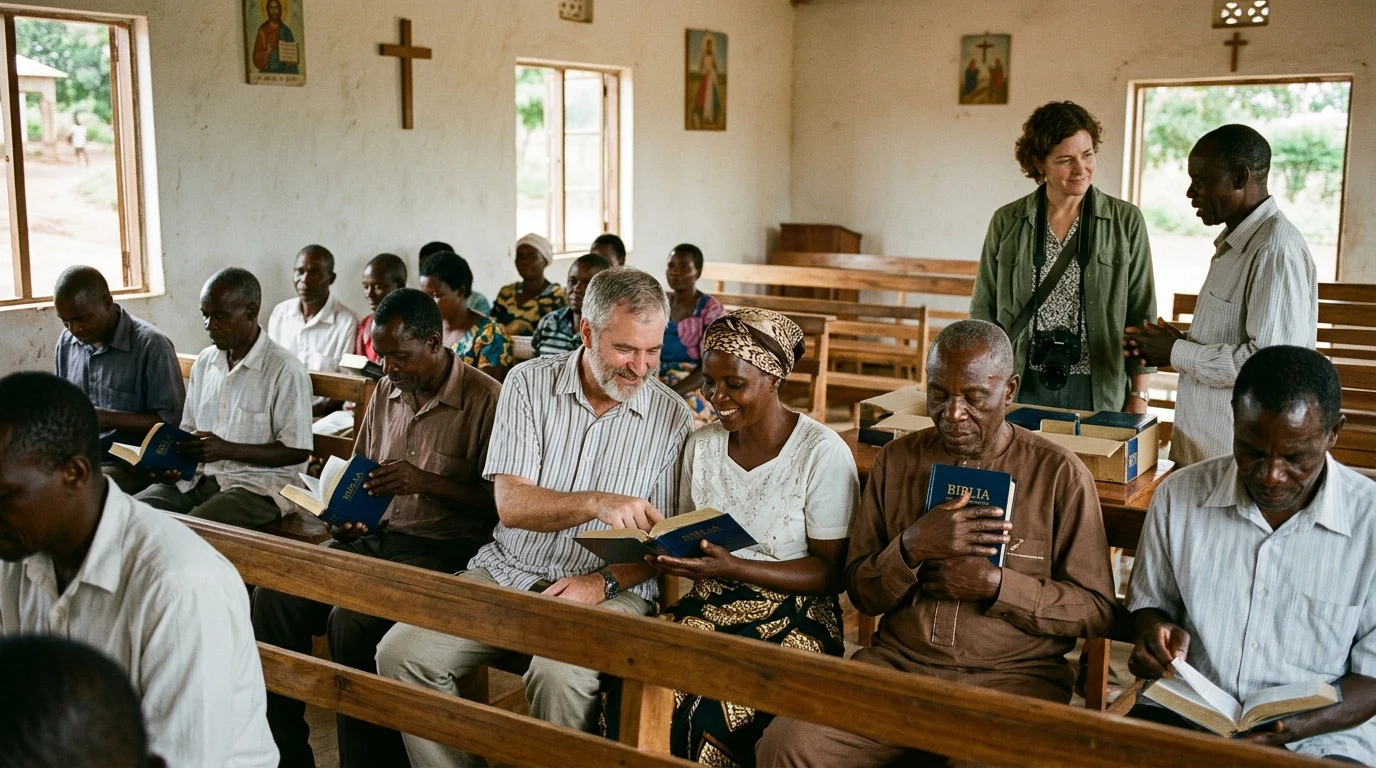
Help Church in Bibles Worldwide — Global Scripture Mission
✨ This article was AI edited. Editorial responsibility: Guardian Church Goods.
Produced with AI. This article was artificially generated. Editorial responsibility: Guardian Church Goods.
Helping churches with Bibles worldwide refers to organized Christian and Catholic missionary initiatives that fund, translate, publish, and distribute sacred scriptures to resource-constrained parishes, persecuted communities, and emerging mission dioceses across the globe to foster spiritual literacy and liturgical life.
In affluent Western societies, the availability of sacred scripture is frequently taken for granted. A typical household may own multiple printed translations of the Holy Bible, supplemented by dozens of digital scripture applications, audio recordings, and theological commentaries. However, for hundreds of millions of faithful Christians across the Global South, rural mission territories, and regions experiencing severe religious persecution, the reality is starkly different: entire congregations often share a single, fragile, dog-eared Bible among dozens of families, and remote catechists travel hours on foot without a complete copy of the Old and New Testaments.
Initiatives dedicated to help church in bibles worldwide represent the fulfillment of Christ’s Great Commission: “Go therefore and make disciples of all nations, baptizing them in the name of the Father and of the Son and of the Holy Spirit, teaching them to observe all that I have commanded you” (Matthew 28:19–20). This comprehensive operational guide examines the global scripture deficit, the biblical mandate for international mission distribution, key Catholic and ecumenical organizations providing Bibles, translation challenges in indigenous languages, and actionable pathways for parishes and individual donors to supply sacred scripture to the universal Church.
Contents
- The Global Scripture Deficit: Understanding the Scale of the Need
- Core Channels: How Major Catholic and Christian Organizations Deliver Scriptures
- Comparison Matrix: Global Bible Distribution Models
- Practical Steps for Parishes and Donors to Support Global Scripture Missions
- Frequently Asked Questions: Helping Churches with Bibles Worldwide
The Global Scripture Deficit: Understanding the Scale of the Need
Sociological and missiological research conducted by organizations such as Wycliffe Global Alliance, the United Bible Societies, and Catholic missionary congregations reveals significant gaps in global scripture access:
- Linguistic Translation Gaps: While the complete Bible has been translated into over 730 languages (representing roughly 5.9 billion people), there remain more than 1,200 languages with only a New Testament, and nearly 1,700 languages without a single translated verse of sacred scripture. Approximately 100 million people lack access to a single book of the Bible in their native mother tongue.
- Economic Barriers to Acquisition: In many developing nations—particularly in sub-Saharan Africa, parts of Latin America, and rural Southeast Asia—the commercial cost of a durable, cloth-bound Bible equals two to four weeks of average household income. For an impoverished agricultural laborer or factory worker, purchasing a personal Bible is an insurmountable financial impossibility without charitable subsidization.
- Liturgical and Ecclesial Deficits: Beyond personal devotional reading, newly established mission chapels and Catholic parishes frequently lack worthy altar Bibles, Book of the Gospels (Evangeliarium), and liturgical lectionaries required for the reverent celebration of the Holy Sacrifice of the Mass and the Liturgy of the Word.
- State Persecution and Clandestine Faith: In nations governed by authoritarian regimes or radical extremist movements, importing, printing, or possessing Christian scriptures is strictly criminalized. In these closed territories, smuggling miniature Bibles, printing clandestine underground editions, and distributing encrypted digital scripture SD cards are vital lifelines for persecuted believers.
Core Channels: How Major Catholic and Christian Organizations Deliver Scriptures
Providing Bibles across international borders requires complex logistics, diplomatic navigation, cultural sensitivity, and trusted local ecclesiastical partnerships. The most effective international scripture distribution pipelines operate through established global networks:
1. Aid to the Church in Need (ACN / Kirche in Not)
Founded in 1947 by Father Werenfried van Straaten (the “Bacon Priest”) and elevated to a Pontifical Foundation by Pope Benedict XVI in 2011, Aid to the Church in Need is the Catholic Church’s premier pastoral charity supporting persecuted and suffering Christians. One of ACN’s most celebrated initiatives is the Child’s Bible (“God Speaks to His Children”). First published in 1979 during the International Year of the Child, ACN’s Child’s Bible has been translated into more than 190 languages and distributed in over 51 million copies worldwide, serving as the primary text for children’s catechesis and adult literacy programs in impoverished regions.
2. The Catholic Biblical Federation (CBF)
Established following the Second Vatican Council’s landmark Dogmatic Constitution on Divine Revelation, Dei Verbum, the Catholic Biblical Federation is an international Catholic association of episcopal conferences and biblical apostolates. The CBF works directly under the auspices of the Vatican Dicastery for Promoting Christian Unity, coordinating translation fidelity, pastoral commentary, and affordable printing subsidies across Latin America, Africa, and Asia.
3. The Gideons International and Scripture Blitz Operations
While historically rooted in Protestant evangelical traditions, the Gideons International have distributed over two billion Bibles and New Testaments across hotels, hospitals, prisons, military bases, and schools in more than 200 nations. In many non-Christian majority nations, a Gideon New Testament in a hotel room represents the first and only exposure an individual ever receives to sacred scripture.
4. United Bible Societies (UBS) and Interconfessional Collaborations
Operating in over 240 countries and territories, the United Bible Societies represent the largest global translation and printing network in the world. UBS frequently collaborates with Catholic episcopal conferences to produce interconfessional translations that include the Catholic deuterocanonical books (such as Sirach, Wisdom, and 1 & 2 Maccabees), ensuring that distributed Bibles meet Catholic canonical standards for liturgical and catechetical use.
Comparison Matrix: Global Bible Distribution Models
| Distribution Mechanism | Primary Target Audience | Key Advantages | Operational Challenges |
|---|---|---|---|
| Subsidized Print Parochial Distribution | Parishioners, catechists, mission chapels | Deep community engagement, pastoral integration, long durability | High maritime freight costs, customs delays, warehouse security |
| Illustrated Children’s Catechetical Bibles | Children, schools, illiterate adult catechumens | Dual role in religious education and basic language literacy | Frequent re-printing required, high illustration licensing costs |
| Audio Bibles & Solar Players | Oral cultures, blind believers, illiterate communities | Bypasses illiteracy, allows communal listening under village trees | Electronic component failures, battery replacement in remote zones |
| Clandestine Micro-SD / Digital Scriptures | Underground churches in closed/persecuted nations | Easily concealed, massive storage (entire library on a fingernail) | Requires compatible smartphone, risk of digital surveillance |
Practical Steps for Parishes and Donors to Support Global Scripture Missions
Parishes, religious orders, and individual Catholic donors can take concrete, highly effective steps to partner with worldwide Bible aid initiatives:
- Organize a Parish “Bibles for Missions” Twinning Campaign: Partner with a Catholic sister diocese in an impoverished region (such as a mission diocese in Papua New Guinea, Kenya, or rural India). Sponsor the printing and shipping of a full container of approved Catholic vernacular Bibles specifically dedicated to newly confirmed teenagers and catechists.
- Support Local In-Country Printing Facilities: Shipping physical books overseas across international shipping lanes incurs heavy freight fees, customs tariffs, and carbon footprints. Modern missiology increasingly prioritizes funding localized printing presses (such as the Paulines Publications Africa in Nairobi, Kenya), which print high-quality Bibles locally at a fraction of Western import costs while supporting local Christian employment.
- Sponsor Indigenous Mother-Tongue Bible Translators: Quality biblical translation requires rigorous exegetical training in biblical Hebrew and Greek combined with native cultural fluency. Sponsoring the annual educational stipends of indigenous Catholic linguists accelerating translation of the New Testament into unreached tribal tongues produces eternal, multi-generational fruit.
- Donate Gently Used Church Bibles and Theological Libraries: When Western Catholic colleges, convents, or parishes merge or upgrade their chapel Bibles and theological libraries, pristine English, French, and Spanish theological books and Bibles should not be discarded. Organizations like Catholic Book Project and Theological Book Network safely ship containers of academic theological texts and Bibles to overseas seminaries that lack physical library holdings.
Frequently Asked Questions: Helping Churches with Bibles Worldwide
Q1: Why is it important to provide specifically Catholic Bibles to overseas churches?
A1: While ecumenical cooperation is commendable, Catholic parishes require complete Bibles containing the 73 canonical books (including the seven deuterocanonical books: Tobit, Judith, Wisdom, Sirach, Baruch, and 1 and 2 Maccabees). Many low-cost Bibles distributed by Protestant mission agencies omit these seven books. Furthermore, Catholic Bibles include essential pastoral footnotes, cross-references, and liturgical lectionary concordances that align with the Catechism of the Catholic Church and the universal liturgical calendar.
Q2: How much does it cost to sponsor a Bible for a believer in a developing nation?
A2: Through volume printing partnerships and subsidized pastoral foundations like Aid to the Church in Need, a durable, complete vernacular Bible can often be printed and distributed for as little as $5 to $10 per copy, while illustrated children’s catechism Bibles frequently cost less than $2 to $3 per volume. A relatively modest financial contribution of $100 can equip an entire rural parish youth group with their first personal copies of scripture.
Q3: Are digital scripture apps replacing the need for physical printed Bibles in mission areas?
A3: While digital smartphone apps (such as YouVersion or the Verbum Catholic app) have expanded access among urban youth in developing nations, physical printed Bibles remain utterly indispensable. In vast rural mission territories, electrical grid access is unreliable, internet data packages are prohibitively expensive, and smartphones are easily stolen or broken. A physical, cloth-bound Bible withstands years of tropical humidity, requires no charging, and serves as a venerated sacred heirloom for the entire extended family.
Published by GuardianChurchGoods.com — Dedicated to sacred scripture distribution, international Catholic missions, liturgical education, and parish supplies.
Get our latest guides, news, and insights highlighted in your Google Search & AI Overviews.


 FINAL WARNING: