
Provide Bibles to Churches Worldwide — Mission Supply Guide
✨ This article was AI edited. Editorial responsibility: Guardian Church Goods.
Produced with AI. This article was artificially generated. Editorial responsibility: Guardian Church Goods.
Providing Bibles to churches worldwide involves comprehensive global church supply initiatives, logistical freight networks, and missionary funding models that manufacture, transport, and distribute sacred scriptures, altar missals, and pew Bibles to under-resourced parishes and Christian mission outposts across international dioceses.
The vitality of any local Christian congregation is inextricably bound to the physical availability and reverent proclamation of sacred scripture. In the Roman Catholic liturgical tradition, the Church has always venerated the divine Scriptures just as she venerates the Body of the Lord (Dei Verbum, 21). When a church gathers for the celebration of the Holy Eucharist, the Liturgy of the Word requires worthy, durable, and beautiful liturgical volumes—from the Book of the Gospels placed upon the altar to sturdy pew Bibles enabling the faithful to follow the readings and deepen their biblical literacy.
However, for thousands of struggling parishes, rural outstations, and missionary dioceses in Asia, Africa, Latin America, and Oceania, acquiring even basic liturgical and parishioner Bibles is a profound challenge. Dedicated programs that provide bibles to churches worldwide bridge this critical gap. This comprehensive operational and theological manual outlines the institutional logistics of global scripture shipments, manufacturing standards for mission climates, funding architectures, customs clearance protocols, and effective ways for dioceses and church goods benefactors to equip growing churches across the globe.
Contents
- The Ecclesial Architecture of Mission Scripture Supply
- Logistical Blueprint: From Western Presses to Remote Mission Altars
- Comparison Matrix: Sourcing & Supplying Global Church Bibles
- How Parishes, Foundations, and Church Goods Suppliers Can Help
- Frequently Asked Questions: Providing Bibles to Churches Worldwide
The Ecclesial Architecture of Mission Scripture Supply
Supplying Bibles to global churches differs dramatically from individual consumer book distribution. Parochial scripture supply requires an understanding of distinct institutional categories, canonical requirements, and communal reading contexts:
1. Altar Bibles & Books of the Gospels (Evangeliarium)
In Catholic and liturgical traditions, the book used at the altar during Mass is not an ordinary personal Bible. The Evangeliarium (Book of the Gospels) is a sacred liturgical object carried in the entrance procession, incensed before the Gospel proclamation, and used by the priest or bishop to bless the congregation. These volumes must feature heavy, acid-free rag paper, large readable rubric typography (typically 14pt to 16pt font), dignified gilded page edges, and durable leather or metal-embossed bindings capable of enduring decades of incense smoke and liturgical veneration. Providing a mission parish with an altar Gospel book elevates the dignity of the entire community’s worship.
2. Parish Pew Bibles and Catechetical Study Editions
In developing parishes, Sunday homilies and weekday Bible studies depend heavily on communal pew Bibles. Because books in communal church pews undergo continuous handling by hundreds of parishioners each week, standard commercial paperbacks quickly disintegrate. Mission-grade pew Bibles require smyth-sewn case bindings, reinforced spine cloth, tear-resistant opaque paper (at least 32–36 GSM), and moisture-resistant polymer or hardboard covers.
3. Vernacular Translation Sets for Catechists and Lay Leaders
In extensive missionary territories, a single Catholic priest may oversee an administrative territory covering twenty to fifty rural outstations. The daily spiritual life, Sunday services of the Word, and sacramental preparation in these outstations are faithfully sustained by lay catechists. Supplying comprehensive Catholic study Bibles—replete with cross-references, pastoral footnotes, maps, and doctrinal concordances in the local vernacular tongue—is the single most effective investment in sustained evangelization.
Logistical Blueprint: From Western Presses to Remote Mission Altars
Transporting tons of sacred books across international borders requires disciplined supply chain management to prevent losses from maritime moisture, customs corruption, and local infrastructure collapse:
- Climatic Resilience & Manufacturing Specifications: Books shipped to tropical mission regions (such as equatorial Africa or Southeast Asia) face severe environmental hazards: high ambient humidity, monsoon rains, and destructive bookbinding insects (silverfish, termites, and booklice). Professional mission Bible publishers utilize PUR (Polyurethane Reactive) glues that do not melt or soften in tropical heat, acid-neutralized paper stock resistant to fungal foxing, and natural insect-repellent vegetable dyes.
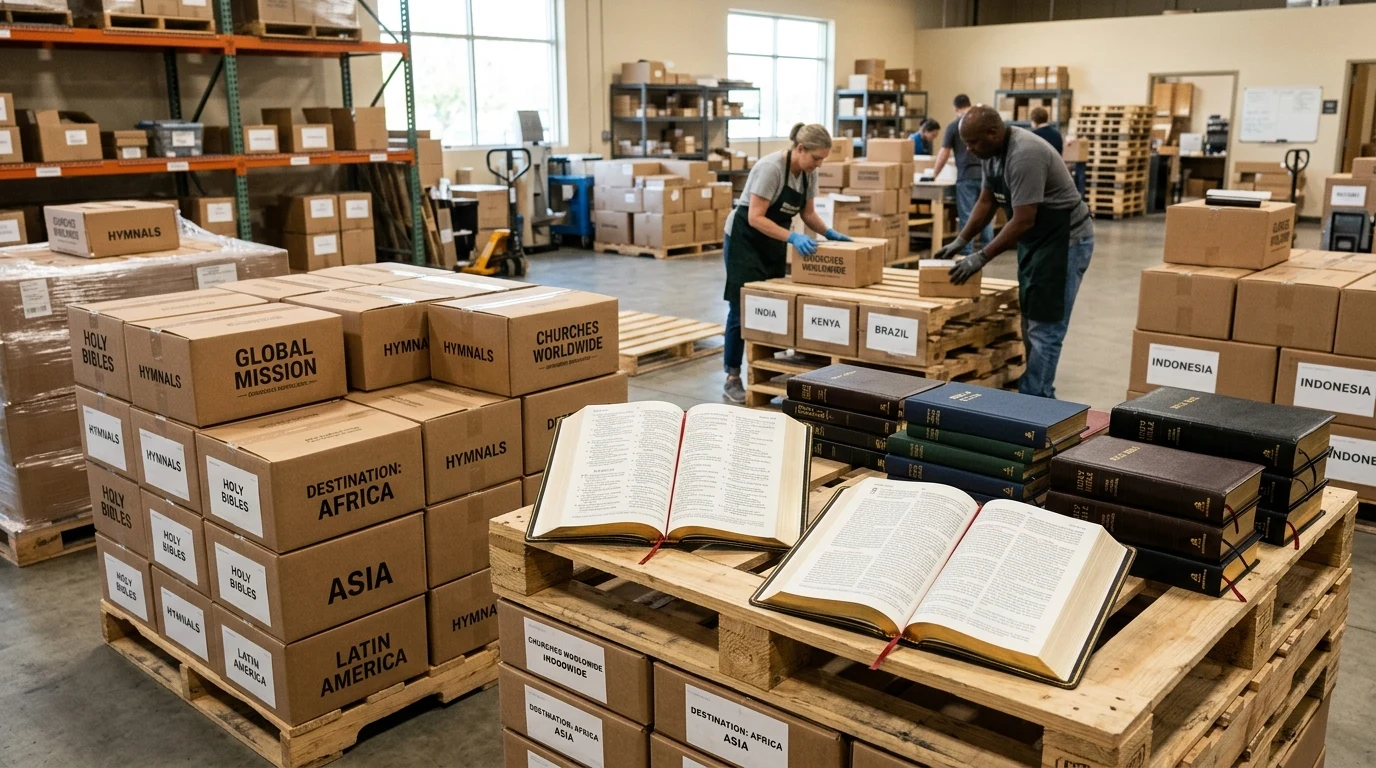
- Intermodal Containerized Freight: Bibles are typically consolidated onto standard wooden pallets, wrapped in heavy-gauge polyethylene moisture-barrier sheeting with industrial silica desiccant bags, and loaded into 20-foot or 40-foot ocean shipping containers. A standard 20-foot container can transport between 15,000 and 25,000 durable hardcover Bibles.
- Customs Exemption & Consignee Protocols: Navigating customs clearance in developing nations requires careful legal preparation. In many nations, commercial book imports attract heavy customs tariffs and value-added taxes (VAT). However, when consigned directly to a recognized national Catholic Bishops’ Conference (or registered non-profit religious NGO) with an official certificate of donation for free religious distribution, shipments are legally exempt from import tariffs. Establishing direct consignee agreements with local diocesan chanceries prevents shipments from being impounded at seaports.
- “Last-Mile” Inland Logistics: The final stage—transporting palletized boxes from deepwater seaports across unpaved dirt roads to remote jungle or mountain villages—is often the most perilous. Mission supply coordinators partner with local diocesan transport trucks, missionary aviation networks (such as MAF), or riverboat barges to ensure that every box arrives safely at rural parish chapels.
Comparison Matrix: Sourcing & Supplying Global Church Bibles
| Bible Category | Target Church Context | Optimal Binding & Paper Spec | Estimated Unit Cost (Subsidized) |
|---|---|---|---|
| Altar Evangeliarium / Book of Gospels | Cathedrals, central parish sanctuaries | Genuine leather, gold gilding, 70 GSM opaque cream paper, ribbon markers | $120–$250 |
| Parish Pew Bible | Congregational pews, chapels | Hardcover buckram cloth, smyth-sewn, 32 GSM bible paper | $6–$12 |
| Catechist Vernacular Study Bible | Rural catechists, seminarians | Flexible vinyl/leatherette, sewn binding, study footnotes & maps | $14–$22 |
| Pocket Mission New Testament | Evangelization rallies, military chaplains, prisons | Softcover coated paper, adhesive PUR bind, compact size | $1.50–$3.50 |
How Parishes, Foundations, and Church Goods Suppliers Can Help
Active collaboration between Western Catholic benefactors, church goods distributors, and overseas missionary chanceries creates powerful, lasting spiritual impact:
- Parish “Adopt-A-Chapel” Scripture Endowment: A suburban parish in the United States or Europe can formally adopt a sister mission chapel in an impoverished diocese. For approximately $1,500 to $2,500, a parish can purchase, ship, and dedicate a complete liturgical scripture suite: an altar Book of the Gospels, two lectionaries, and 150 durable pew Bibles imprinted with the name of the recipient church.
- Matching Grants with Mission Foundations: Philanthropic foundations and church goods suppliers frequently partner with organizations like Aid to the Church in Need, Cross International, or Catholic Near East Welfare Association (CNEWA) to provide matching grant funds. Every dollar contributed by individual donors is doubled to purchase containers of scriptures directly from certified in-region publishing houses.
- Supporting Regional Translation and Printing Hubs: Rather than relying exclusively on transatlantic freight, supporting regional Catholic printing houses—such as Pauline Publications in Africa and the Claretian Missionaries in the Philippines—empowers local church bodies to produce high-quality Catholic Bibles tailored to native languages and cultural aesthetics at highly competitive local pricing.
Frequently Asked Questions: Providing Bibles to Churches Worldwide
Q1: What are the main challenges when sending Bibles to churches in non-Christian countries?
A1: In nations where Christian missionary activities are legally restricted or heavily monitored by state authorities, importing large quantities of Bibles through standard commercial freight channels can result in confiscation, heavy fines, or persecution of local recipients. In these sensitive environments, scripture delivery relies on discrete overland transport networks, authorized domestic church associations (where legally permitted), and encrypted digital distribution channels designed to safeguard the safety of local clergy and believers.
Q2: Why do mission churches prefer hardcover or durable leatherette over inexpensive paperback Bibles?
A2: While paperback editions appear attractive from a low-cost volume perspective, they deteriorate rapidly in high-humidity tropical climates. Moisture causes paperbacks to warp, and heat causes standard thermal glues to dry and crack within months, causing pages to fall out under heavy congregational use. A smyth-sewn hardcover or vinyl-bound Bible lasts 10 to 20 years in a church pew, delivering vastly superior long-term stewardship and pastoral utility.
Q3: How do donors ensure that shipped Bibles are actually distributed to churches rather than sold in commercial markets?
A3: Reputable scripture distribution ministries maintain strict chain-of-custody protocols. Shipments are consigned directly to verified diocesan chanceries, missionary superiors, or registered non-profit trustees. Upon arrival, local coordinators maintain distribution ledgers recording the specific parishes, mission stations, and catechists receiving the books, accompanied by photographic confirmation and pastoral audit reports provided back to benefactors.
Published by GuardianChurchGoods.com — Dedicated to sacred scripture distribution, church goods logistics, Catholic liturgical life, and missionary parish support.
Get our latest guides, news, and insights highlighted in your Google Search & AI Overviews.


 WAIT! YOUR DIVINE CONNECTION IS BLOCKED