
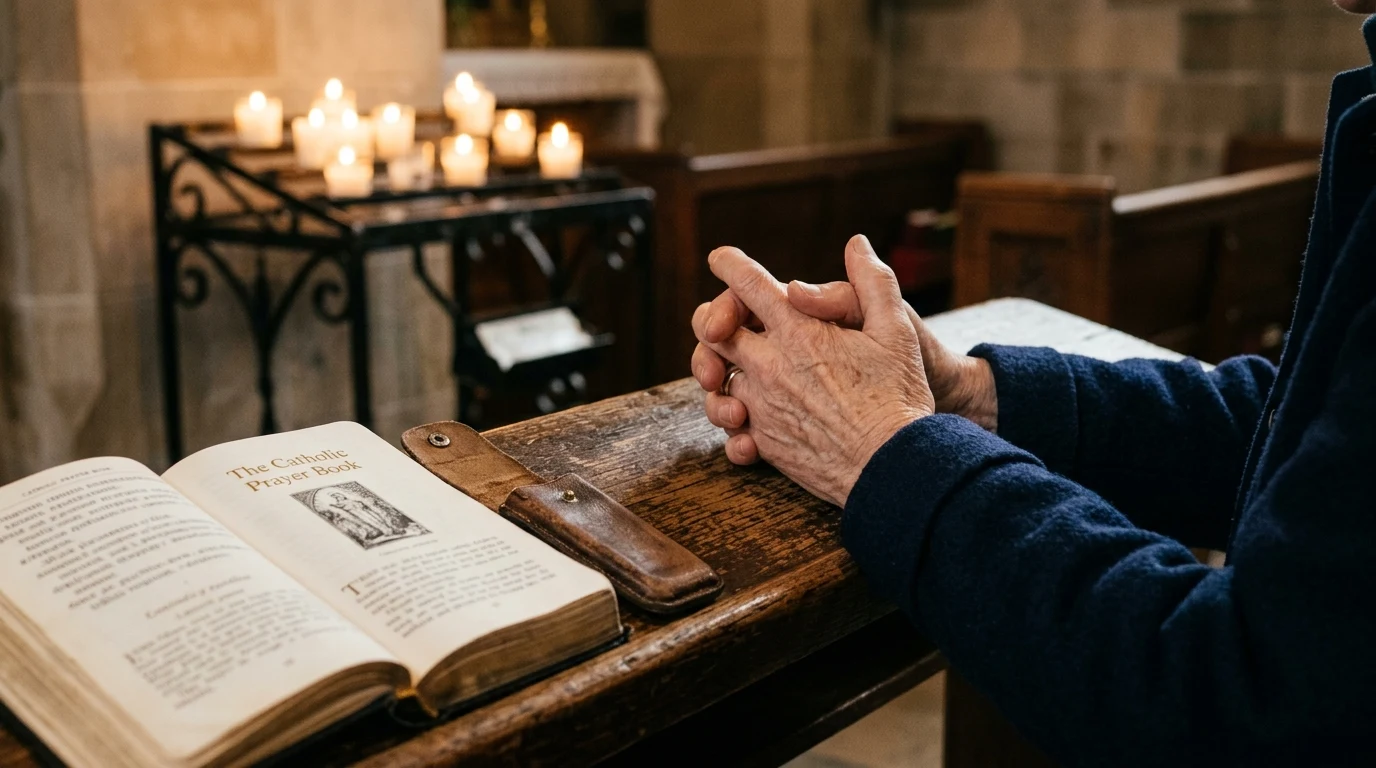
Praying 50 Hail Marys Without a Rosary — Complete Guide
✨ This article was AI edited. Editorial responsibility: Guardian Church Goods.
Produced with AI. This article was artificially generated. Editorial responsibility: Guardian Church Goods.
Praying 50 Hail Marys without a rosary is a traditional Catholic devotional practice where believers recite the five decades of the Holy Rosary using finger counting, knuckle segments, mental pacing, or breath rhythms to complete the Marian devotion and gain its spiritual merits when physical beads are unavailable.
The Holy Rosary is one of the most treasured, universally practiced, and spiritually potent devotions in the Roman Catholic Church. Promoted by saints, popes, and the Blessed Virgin Mary in approved apparitions from Saint Dominic to Fátima, the Rosary combines vocal prayer with deep scriptural meditation on the joyful, luminous, sorrowful, and glorious mysteries of the life, death, and resurrection of Jesus Christ.
However, dedicated rosary lovers frequently encounter moments in daily life where a physical set of beads is unexpectedly missing: while driving a commute, jogging on a nature trail, lying awake in a dark hospital bed, passing through airport security checkpoints, or walking between office meetings. In these situations, believers often wonder: Can I still pray a valid and spiritually fruitful Rosary without beads? How do I keep accurate track of 50 Hail Marys? Does the physical rosary object possess magical necessity, or is it merely an aid to interior prayer?
The Catholic spiritual tradition provides a resounding, comforting answer: the Rosary resides in the heart, the mind, and the voice, not in the string of beads. Physical rosary beads are blessed sacramentals designed to facilitate counting, but the lack of beads should never prevent a soul from offering 50 Hail Marys to the Queen of Heaven. This comprehensive manual details the theology of bead-less recitation, practical finger and knuckle tracking techniques, pacing methodologies, and how to maintain deep contemplative immersion anywhere, anytime.
Contents
The Theology of the Rosary: Form, Matter, and Sacramentals
To pray with confidence without physical beads, one must understand the theological distinction between a Sacrament and a Sacramental:
- Sacraments (Instituted by Christ): The seven Holy Sacraments (such as Baptism and the Holy Eucharist) require strict, essential matter and form for validity. A priest cannot confect the Eucharist with soda and cookies, nor can a baptism occur without water and the Trinitarian formula.
- Sacramentals (Instituted by the Church): Physical rosary beads are sacramentals—holy objects blessed by a priest or deacon that prepare the soul to receive grace and inspire devotion (Catechism of the Catholic Church, 1667–1670). While blessed beads carry the Church’s liturgical blessing, the essence of the Rosary devotion is the interior contemplation of the sacred mysteries coupled with the vocal recitation of the Lord’s Prayer, the Angelic Salutation (Hail Mary), and the Doxology (Glory Be).
Saint Louis-Marie Grignion de Montfort, in his spiritual classic The Secret of the Rosary, explicitly affirmed that the essential value of the Rosary lies in the purity of intention, attentiveness to the mysteries, and filial love for Christ and Mary. Saint Teresa of Ávila likewise taught that vocal prayer without interior attention is like a body without a soul. Therefore, an attentive, devout Rosary prayed counting on one’s fingers possesses infinitely greater spiritual fruit than a distracted, mechanical rattling of solid gold rosary beads.
Practical Techniques for Tracking 50 Hail Marys Without Beads
Catholic tradition has developed ingenious, time-tested methods for accurately counting five decades (50 Hail Marys) using the natural tools God provided: our ten fingers.
1. The Standard Ten-Finger Method
The most straightforward and universal technique utilizes the ten fingers of both hands:
- Tracking the Decades (Left Hand): Use your left hand to track which decade you are currently praying. Touch your left thumb to your index finger for Decade 1, middle finger for Decade 2, ring finger for Decade 3, pinky for Decade 4, and palm for Decade 5.
- Tracking the Hail Marys (Right Hand): Use your right hand to count the ten Hail Marys within that decade. Begin with the thumb (Hail Mary 1) and progress sequentially through each finger to the pinky (Hail Mary 5). For Hail Marys 6 through 10, count back down from the pinky to the thumb, or gently curl each finger into a loose fist and unfold them one by one.
2. The Knuckle and Phalanx Segmentation Method
For individuals who prefer one-handed prayer (such as drivers with one hand on the steering wheel or patients lying immobilized), the three segments (phalanges) of the four fingers provide a built-in twelve-point counting grid:
- Each of the four main fingers (index, middle, ring, pinky) has three distinct segments separated by joint creases, providing 12 natural segments.
- Using your thumb as a tactile stylus, tap the base, middle, and tip of the index finger (Hail Marys 1–3), middle finger (Hail Marys 4–6), ring finger (Hail Marys 7–9), and the base of the pinky (Hail Mary 10).
- This method is completely invisible, silent, and can be practiced discretely inside a coat pocket during a business meeting or public transit ride without drawing attention.
3. The Temporal Pacing & Breath Method
Experienced devotees who have prayed the Rosary daily for years develop a deeply ingrained internal rhythm:
- A reverently recited Hail Mary—prayed slowly, emphasizing the Holy Name of Jesus at the hinge of the prayer—takes between 12 and 15 seconds.
- A full decade (one Our Father, ten Hail Marys, one Glory Be, and one Fatima Prayer) naturally spans approximately 2.5 to 3 minutes.
- By anchoring each decade to a five-minute block of time or a specific stretch of a walking route (e.g., from your front door to the corner streetlight is Decade 1), you can completely release anxiety about exact numerical counts and immerse your imagination entirely in the mystery.
- If you accidentally pray 9 or 11 Hail Marys, the Blessed Mother does not deduct grace! As Saint Thérèse of Lisieux observed, Mary is our Mother, not an exacting accountant. She receives the fragrance of our prayer with tender motherly love.
Comparison Matrix: Bead-Less Rosary Counting Methodologies
| Counting Methodology | Physical Requirement | Best Situational Application | Discretion Level |
|---|---|---|---|
| Two-Hand Ten-Finger System | Both hands free | Walking, sitting in church, personal quiet time | Moderate (visible hand movements) |
| One-Hand Knuckle Grid (Phalanges) | Single hand only | Commuting, holding child, hospital bed, coat pocket | Maximum (completely imperceptible to onlookers) |
| Rosary Finger Ring / Ten-Notch Ring | Worn jewelry piece | Daily office work, driving, athletic exercise | High (looks like an ordinary piece of jewelry) |
| Temporal Route / Breath Anchoring | Zero physical touch | Jogging, cycling, swimming, complete paralysis | Absolute (pure interior operation) |
Deepening Interior Contemplation: The Soul of the Rosary
Pope Saint John Paul II, in his apostolic letter Rosarium Virginis Mariae (2002), cautioned that without contemplation, the Rosary is a body without a soul, risking mechanical repetition. When praying 50 Hail Marys without beads, leverage the absence of physical objects to deepen your interior visualization of the biblical scenes:
- Announce the Mystery Solemnly: Before each decade, state the mystery aloud or interiorly (e.g., “The First Sorrowful Mystery: The Agony in the Garden”). Formulate a concrete fruit of the mystery you wish to ask for (e.g., “Sorrow for sin and conformity to God’s will”).
- Linger on the Holy Name of Jesus: Pope John Paul II emphasized that the Holy Name of Jesus is the center of gravity of each Hail Mary. As you recite: “…and blessed is the fruit of thy womb, JESUS…”, pause for a moment of interior adoration, mentally linking the mystery to Christ (e.g., “…Jesus, sweating blood in Gethsemane…”).
- The Scriptural Clause Insertion Method: An ancient Carthusian practice involves adding a brief clause after the name of Jesus in each Hail Mary to anchor wandering thoughts. For example, during the Joyful Mysteries: “…Jesus, whom thou didst conceive of the Holy Spirit…” or during the Glorious Mysteries: “…Jesus, who rose gloriously from the dead…”.
Frequently Asked Questions: Praying 50 Hail Marys Without Beads
Q1: Can I gain the plenary indulgence attached to the Rosary if I don’t use physical beads?
A1: Yes. The Enchiridion Indulgentiarum (Manual of Indulgences, Grant 17) grants a plenary indulgence under the usual conditions (sacramental confession, Eucharistic communion, prayer for the Pope’s intentions, and detachment from all sin) to the faithful who recite five continuous decades of the Rosary devoutly in a church, public oratory, family group, religious community, or pious association. The norm specifies vocal recitation and devout meditation on the mysteries; it does not mandate that the beads themselves be physical, provided the decades are recited in unbroken succession with proper meditation.
Q2: What if I lose count and accidentally pray 9 or 12 Hail Marys in a decade?
A2: Rest in peace: God is a loving Father, not a computer verifying a mathematical formula. The number ten is a traditional biblical number representing completeness (the Ten Commandments, the ten righteous men of Sodom), but the spiritual value of the prayer comes from the love, repentance, and contemplation offered to God through Mary. If you realize you skipped one or added an extra, simply continue forward with peace.
Q3: Is it respectful to pray the Rosary while exercising, cleaning, or driving?
A3: Absolutely. Saint Paul commanded: “Pray without ceasing” (1 Thessalonians 5:17). Weaving the 50 Hail Marys into the ordinary fabric of daily labor, commutes, and chores sanctifies daily life. While setting aside quiet, uninterrupted time in church or a home prayer corner is ideal, sanctifying our daily activities with the rhythm of the Rosary is a hallmark of Catholic spirituality practiced by saints across centuries.
Published by GuardianChurchGoods.com — Dedicated to Catholic devotional life, sacred Rosary traditions, Marian theology, and church supplies.
Get our latest guides, news, and insights highlighted in your Google Search & AI Overviews.


 YOUR WEALTH MANIFESTATION BEGINS IN 3...2...1...